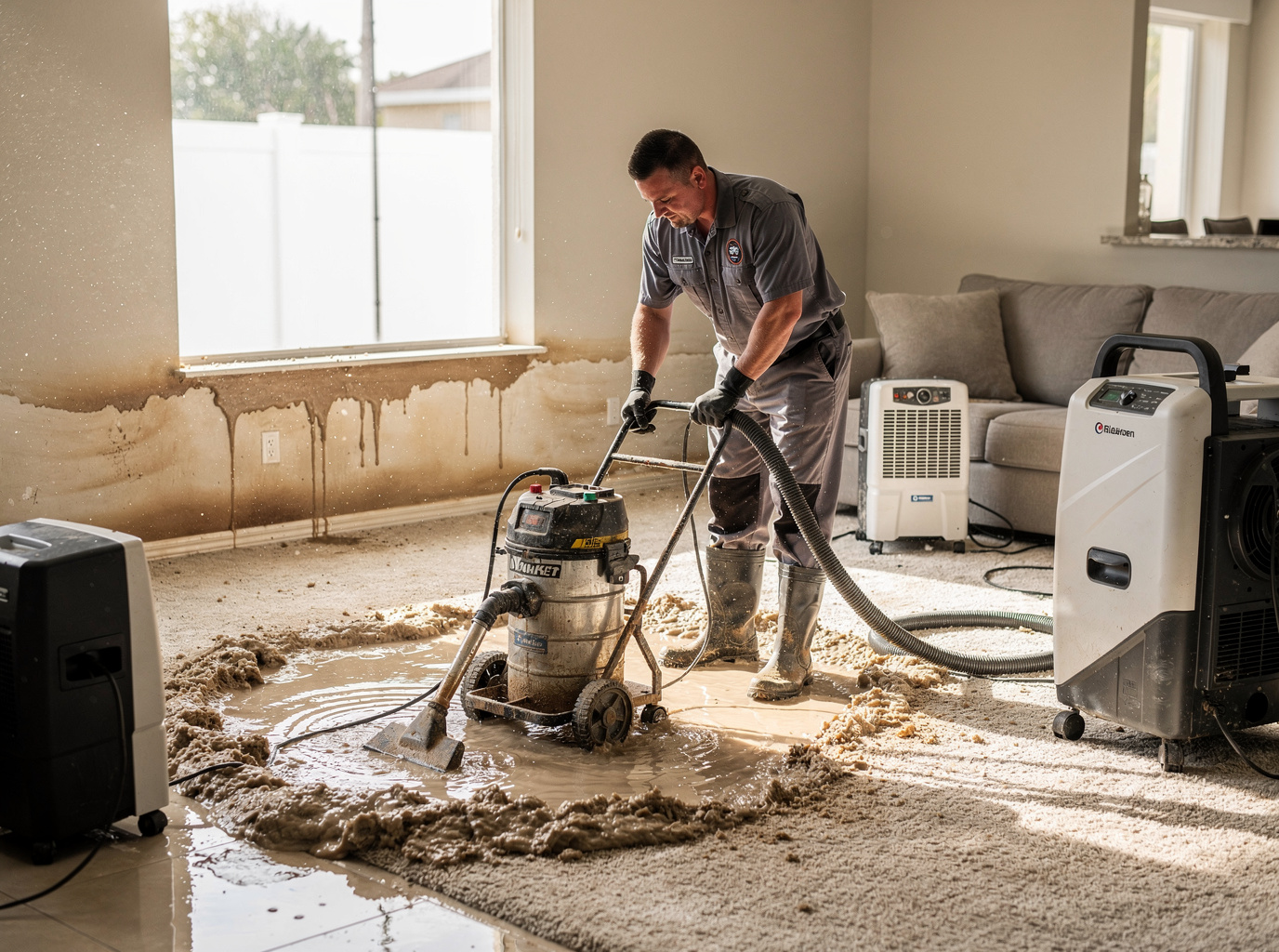
Orlando's humid subtropical climate brings frequent afternoon thunderstorms that overwhelm older drainage systems in neighborhoods like College Park and Ivanhoe Village. Homes built before 1980 often have plaster walls and slab foundations that trap moisture, requiring infrared moisture mapping and industrial air movers rather than basic fans. Technicians must account for how high groundwater tables near Lake Eola Park slow natural evaporation and increase the risk of hidden saturation in crawl spaces.
In areas such as Baldwin Park and Mills 50, stucco exteriors on mid-century homes allow water to wick behind siding during heavy rains, leading to delamination if extraction skips the wall cavities. Cleanup crews use HEPA air scrubbers and antimicrobial solutions rated for Category 2 water to prevent bacterial growth accelerated by 90-plus percent humidity levels common from June through September. Work in Thornton Park historic districts also requires careful handling of original hardwood floors to avoid cupping during forced drying.
Service calls to Winter Park and Altamonte Springs frequently involve roof leaks around skylights or HVAC condensate lines that drip into finished ceilings. Technicians document moisture content at multiple depths in drywall and subfloors before removal, since Orlando's clay-heavy soils retain water longer than sandy coastal areas and extend drying timelines by several days.
Coordination with Orange County permitting is sometimes needed when water intrusion affects electrical panels or load-bearing elements in multi-story buildings near the Dr. Phillips Center. Crews prioritize negative air pressure setups in attached units to keep contaminants from migrating into neighboring properties during sewage or gray-water events.
Technician insight
In Orlando the thing that catches most people out with Water Damage Cleanup is how quickly afternoon thunderstorms push water behind stucco in Baldwin Park and College Park homes; homeowners stop at visible puddles and miss the slab-edge saturation that keeps humidity high for days afterward.
Burst Supply Line in Winter Park Residence
A kitchen supply line failed overnight in a 1960s home near Harry P. Leu Gardens, saturating cabinets and the adjacent dining room. Extraction revealed moisture had traveled under the slab into the laundry area. Crews removed baseboards, placed drying mats under the hardwood, and ran dehumidifiers for four days until readings returned to normal.
Water Damage Cleanup Services We Offer
✓Emergency Water Extraction
Rapid removal of standing water from living spaces using truck-mounted pumps and portable extractors suited to Orlando's sudden thunderstorm flooding.
✓Flooded Basement Cleanup
Pumping and sanitizing below-grade spaces common in College Park and Baldwin Park homes where high water tables meet older foundation drains.
✓Carpet and Rug Water Damage Cleanup
Deep extraction and antimicrobial treatment for wall-to-wall carpet and area rugs to stop mold growth in humid Orlando conditions.
✓Hardwood Floor Water Cleanup
Controlled drying and board removal for original hardwood floors found in Ivanhoe Village and Thornton Park properties to prevent permanent cupping.
✓Sewage Cleanup and Sanitation
Full removal and disinfection of contaminated water from backups, using EPA-registered agents safe for occupied homes near Downtown Orlando.
✓Ceiling and Wall Cavity Drying
Targeted drying behind drywall and in stucco wall cavities after roof or plumbing leaks common in Mills 50 and Winter Park residences.
Water Damage Cleanup Cost in Orlando, FL
| Service | Typical Range | What Affects It |
|---|---|---|
| Initial Moisture Assessment | $150–$350 | Varies with property size and number of affected rooms in Orlando homes |
| Water Extraction | $400–$1,200 | Higher for Category 3 water or multi-room involvement common after storms |
| Drying Equipment Rental | $300–$900 | Daily rate influenced by how long humidity keeps materials wet |
| Sanitation Treatment | $200–$600 | Depends on water source and square footage requiring antimicrobial application |
Ranges are typical for Orlando, FL and confirmed with an exact written quote before any work starts.
How it works
- 1
On-Site Assessment
Technicians arrive from the 440 Santiago Ave base, document water category, and map moisture in affected rooms using meters and thermal imaging.
- 2
Water Removal
Standing water is extracted with appropriate pumps while protecting salvageable materials in homes across Orange County.
- 3
Drying And Dehumidification
Air movers and dehumidifiers are placed to bring moisture levels down, with daily monitoring adjusted for Orlando's high ambient humidity.
- 4
Sanitation And Clearance
Antimicrobial application and final moisture checks confirm the space is ready for repairs before equipment is removed.
Pricing
Costs depend on water category, square footage affected, and drying duration required by local humidity levels.